Sunday, June 23, 2013

ATINDRANATH DAS feels that we should have zero tolerance for violation of child rights

http://www.thethumbprintmag.com/content.php?cat=On%20the%20Margins&content=Revive%20Child%20Rights

Photo: Bal Sakha, a CRY-supported NGO working in Dibrugarh
A little boy with a pair of bright twinkling eyes, Durga Prasad Borah is just like any other teen age kid one can come across along the course of the Brahmaputra, our very own Lohit River. Durga lives at Pohari Khonia, a small village at Borboruah Block, around 15 kilometres away from Dibrugarh city, Assam.
At the tender age of 14 Durga Prasad is supposed to be in school, but instead, one finds him busy with fishing all through the day along the banks of the Brahmaputra. Be it a rainy morning or a chilly winter afternoon, instead of spending time with his friends within the classroom, he is busy with his mundane job of fishing with a tattered net in his hands.
Durga Prasad is no stranger to hard work, though. Being the elder of two brothers, he was compelled to drop out of school in December, 2011, and start working in order to help his father Wokil Borah, who is also a fisherman by profession. His story, however, took a positive turn as he came in contact with the Children’s Group organised by ‘Bal Sakha’ (a CRY-supported NGO working in Dibrugarh District in Assam) and expressed interest to continue his studies. But he was not sure if his father would allow him to go back to school. The project workers then talked to Wokil Borah, Durga’s father. To cut a long story short, they finally persuaded him, and brought the little child back to school.
But for the multitudes of little children like Durga Prasad, saying no to Child Labour and walking back to the arena of education is anything but a smooth sailing. There are millions of children all across India, and child labour is to be found in almost every sector of the informal economy. Millions of children are engaged as child labours in workshops and small factories; in dhabas and roadside tea-stalls; in brick kilns and bidi-rolling industries; on the streets and as well as domestic servants. A huge number of children are also to be found in the agricultural sector.
In 1992 when India ratified the United Nations Convention on the Rights of the Child (UNCRC), a reservation was made in article 32, wherein the Government of India articulated that it would progressively ban all forms of child labour, given our economic condition. 21 years hence, we are still speaking about regulating and prohibiting child labour.
More recently, the government of India proposed to amend the Child Labour Prohibition and Regulation Act. The attempt to amend the existing legislation however seems to emerge from the need to do away with the contradiction between the Fundamental Right to Education Act (RTE Act) and the existing Child Labour Act than to completely eradicated child labour.
The amendment categorises children into two groups i.e. Child and adolescent; all persons below 14 year of age being defined as a child and persons between the ages of >14 - <18 a="" adolescents.="" as="" being="" between="" children="" defined="" definition="" for="" is="" it="" new="">14-<18 18="" 2000.="" 3="" 65="" a="" act="" adolescents="" all="" allowed="" amendment="" and="" are="" as="" barring="" be="" been="" but="" can="" child="" considerations="" contrary="" definition="" does="" earlier="" economic="" for="" has="" if="" in="" including="" justice="" justification="" juvenile="" labour="" listed="" mean="" mentioned="" nation="" not="" number="" occupations="" of="" only="" p="" processes.="" processes="" proposed="" provided="" redrawn="" restricted="" sanction="" schedule="" should="" some="" that="" the="" this="" those="" three="" to="" uncrc="" under="" used="" were="" which="" work="" years="">
In the three decades CRY has been working to restore the rights of children in India, we have learnt that domestic work can be extremely exploitative, abusive and violates every right of a child. A child of 14 or 16 years is equally, if not more, vulnerable to abuse and exploitation as a child of 12 or 13 years when it comes to working as domestic help. This can very well be the situation in the context of other occupations as well. Given that India’s track record in implementing legislation is so poor, how are law makers going to ensure the safety of adolescents? What safeguards are being prescribed and put in place? In fact, CRY’s experience has been that children in the >14 - <18 -="" abuse.="" age="" agriculture="" and="" are="" as="" construction="" dhabas="" employed="" exploitation="" exposed="" garages="" group="" helpers="" highly="" in="" labourers="" leave="" many="" mental="" motor="" of="" often="" p="" physical="" road="" sectors="" services="" side="" sites="" that="" them="" to="" transport="" travel="" types="">
Interestingly, the National Policy for Children 2012 (NPC) defines the child as persons who have not completed 18 years of age and reaffirms the Government’s commitment to the realisation of the rights of all children in the country, as it states that it will guide and inform all policies, laws and programmes concerning children. But one does not get any clarity on if this means that all legislations pertaining to children will now have a uniform definition of a child. If the NPC is indeed committed to realise all rights of all children in India, then the proposed amendment to the Child Labour Act is meaningless. It remains to be seen how and what attempts will be made to align the definition of a child in the various legislations concerning children with the National Policy for Children.
It is high time the government took drastic steps to clear all confusion regarding setting the age of a child to exercise their right. Child Labour is a matter of national shame, a blatant violation of human rights by the establishment. The very circumstances that drive a child to seek employment- often iniquitous in terms of remuneration, is violation of children's rights for which it is not only the parents but largely the establishment that should be held responsible.
Child labour has, in a way, become a social norm and we accept and tolerate it in our society. Unless we, as a society, have zero tolerance towards such issues, this exploitative and abusive practice will continue. Today, the quintessential goal of children’s happiness and wellbeing is constantly disregarded. Children’s sorrows and chagrins - for not being able to go to school, for living in poverty, for bleak home lives – doesn’t seem to garner much attention. What we need most today isto restore to Indian children their basic rights,revive humanity and create a society where children can live with dignity and exercise their rights in order to lead a happy life. If we are serious about creating a happy, prosperous nation we must begin with children. We need to put children first in everything we do.
The government should amend the law to ensure that all forms of child labour are prohibited for children up to 18 years of age. CRY considers all those between 0 to 18 years of age to be children. And we urge the government to bring uniformity in law when it comes to the definition of a childas provided in the UNCRC.
The author, Atindranath Das, is Regional Director (East), CRY – Child Rights and You started his career in the development sector as a Child Rights activist three decades back. He is associated to CRY for the last 20 years.

Saturday, June 22, 2013

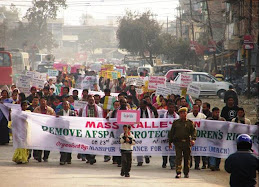
Rally in Ukhrul- Manipur against Right violation of women and children


Convention on Right to Education begins

http://www.ifp.co.in/nws-15072-convention-on-right-to-education-begins/

IMPHAL, June 22: Manipur Alliance for Child Right (MACR), Thoubal branch in association with Nehru Yuba Kendra, Thoubal has today convened a discussion program on Right to Free and Compulsory Education 2009 which is popularly known as RTE at the Election Counting Hall in the complex of Deputy Commissioner Thoubal, in which L Nabakishwor Singh (IAS), ADM Thoubal, E Manglemjao Singh, Up-Adakshya of Thoubal Zilla Parishad and Sh Budhi Singh, ZP of Langathel were on the dais as president, chief guest and guest of honour respectively.

While giving her key note address on the convention, Narengbam Nonibala Devi said that MACR has been working to render child related services which are guaranteed by the constitution of India and further saying that to protect the right of the child is an obligation for the governments, both at the state and centre. However, realizing the rights by the children is still a big question as there are cases of child rape and abandoning of newly born children in Manipur. Even though, government is formulating child related laws such as Juvenile Justice Act and RTE, their protection and security is still uncertain.

She further said that this program is being organised to make aware the general public and attention of the stake holder of the child related problems and further mentioning that school dropout children is increasing while child labour and sexual assault are also becoming a never ending state issue, said it.

Afterward, there was a technical session in which K Pradip, Convener of MACR delivered a lecture on the topic ‘Implementation Gaps and Challenges of RTE’ while H Priyokumar, Deputy Inspector of Zone III was a resource person on the topic ‘Provision of Children’s Education under RTE’. T Rameshwor, retired teacher moderated while the head masters of various schools and members of MACR participated the technical session, said it.

Wednesday, June 12, 2013

`Children`s Right to Protection is below the average in Thoubal District` `“Mala Lisam

IMPHAL, June 12: The chairperson of the Child Welfare Committee (CWC) Thoubal district, Mala Lisam today said “the universally acknowledged right of the children for their protection is below the average in Thoubal district.” This statement was made in the discussion on ‘Juvenile Justice Act 2000’ which was organised in the conference hall of the Integrated Rural Development Service Organisation IRDSO, Wangjing.
Mala Lisam has lectured on ‘Structure and Legal Provision under Juvenile Justice Act, 2000’ (known as JJ Act) mentioning that there are provisions in JJ Act for the welfare and wellbeing of the children. She said that if a child involved in a crime, the child should be treated fairly in order to trace the cause of the crime. Under the provision of JJ Act, no children should be awarded severe punishment. She further said that right of life, right to grow, right to protection and right to participate is mandatory while mentioning that the follow up programme after rehabilitation was zero in Manipur.
Under ‘after case programme’ of the Integrated Child Protection Scheme (ICPS) of the government of India, there is provision for providing an amount of Rs. 500 but this facility was not available due to non implementation of the scheme, said the chairperson.
The chairperson also expressed concerns on the killing of girl child and rejecting of girl child after childbirth thereby throwing away girl child in Manipur.
Another resource person K Meghachandra Singh, SDPO Yairipok was also delivered on the topic ‘Crime against Children and Juvenile Police Unit’ articulating that there were intermittently misunderstandings between public and police in handling an investigation under juvenile justice case by juvenile police unit and expressing that cooperation is necessary for better result. The SDPO further said that district Police have supervised all police officers who are handling woman and child related cases for smooth and steady closure of their cases.
Nonibala Narengban, secretary IRDSO said in her key note address that ‘crime against child is higher in Thoubal district than other district’ revealing statistics that ‘out of the 12 cases of child missing in the entire state in the year 2012, Thoubal district shared 5 cases while 5 rape cases of girls were from the same district out of the 11 cases of the entire state.’ The secretary added that ‘a new case was found from every public discussion which demanding a concerted effort of the law enforcing agency, judiciary, medical department etc’, said it.
In today’s discussion, the reporter of AIR, Thoubal also delivered on the topic ‘Crime against Children and Media’ while Md Riaz JJ Board member, Thoubal talked on the care and concern of the child. S Sorojini Devi secretary of All Manipur Nupi Marup was moderated the function.
The discussion programme made the following recommendation: implement child marriage prohibition Act; provide rape victim trauma counseling centre to all districts; etc.

Friday, June 7, 2013

Implementation of ICDS, ICPS in total disarray: Nina Nayak

The implementation of the ICPS, ICDS and Juvenile Justice Act in Manipur is in total disarray, asserted Nina P Nayak, Member of National Commission for Protection of Child Rights (NCPCR).
She was speaking to media persons after an open discussion on the concerns and challenges on issues related to the implementation of different schemes for child rights which was organized by Manipur Alliance for Child Rights and supported by CRY (Child Rights and You) at Hotel Nirmala on Friday.
Nayak stated that the main purpose of her visit to Imphal was to inspect the rehabilitation facilities provided by the state government to the 23 children rescued from an orphanage home at Jaipur on March 12, 2013. She said it was found that the police have not even filed an FIR against the main accused, Jacob John.
For this purpose she visited Ukhrul from where majority of the children came from. During a two hour long discussion with the Deputy Commissioner of Ukhrul District, the latter informed her that five persons including Jacob John were booked on charges of child trafficking and sexually abusing the children.
She stated that during her visit to Ukhrul she came across the plight of the staffs of the Integrated Child Protection Scheme (ICPS) office there, all of whom have not been paid their salaries for the last one year. Above these, there are complaints regarding the failure to provide the facilities guaranteed under the RTE Act, she asserted adding that the DC had been made aware of the situation and urged to look into it.
She also narrated about her visit to the adoption centre at Bishnupur District informing that she found out that there was not a single child there and the agency has been violating all the laws prescribed for adoption. There are around seven adoption agencies in the state but maximum of them are not functioning properly.
She also stated that the system and the structure of several schemes in the state are not in place. The Manipur State Commission for Protection of Child Rights (MSCPCR) had been established but there are no adequate infrastructure and staff. Since Manipur is an insurgency prone area, the Government needs to show more concern for the children, she stated adding that they should be given proper care and assured the enjoyment of the facilities given by the Central Government. MSCPCR has a great role in implementing such schemes successfully, she said.
“NGOs in the state working in this field are doing a great job but they have not succeeded in persuading the legislators to get them involved in movements for protection of the rights of the child” she said adding without their involvement the movement will not gain momentum as only they can bring up such issues at the Assembly.

Need To Set Up Fast Track Courts To Try Child Molestors Mooted Children issues highlighted to NCPCR

http://www.thesangaiexpress.com/tseitm-27041-need-to-set-up-fast-track-courts-to-try-child-molestors-mooted-children-issues-highlighted-to-ncpcr/


IMPHAL, Jun 7: A number of NGOs and child right activists today highlighted the various problems and issues being faced by children in Manipur to National Commission for Protection of Child Rights (NCPCR) Member Nina P Nayak during a consultative meet held at Hotel Nirmala here today.
The consultative meeting held at the initiative of Child Rights and You and the Manipur Alliance for Child Rights deliberated on JJ Act, ICPS, ICDS, Prevention of Child Sexual Offence Act, child trafficking and migration etc.
Speaking at the meeting Pradip of the Manipur Alliance for Child Rights said that children in Manipur are being denied their fundamental rights because of the protracted armed conflict situation.
Whereas many children have been victimised by the twin issue of HIV and drugs, the State Government is shying away from its responsibility, said the NGOs.
As women helpline is not opened in all districts of Manipur, girls often find themselves in the event of any harassment or sexual violence. Pradip also highlighted the urgent requirement of setting up fast track courts for speedy trial of all accused involved in sexual violence.
There are around 12 children homes in the State which are being run with grants given by Government. But the Government has not been releasing necessary fund/grants in time. For this year too, no fund has been released so far.
The Manipur State Commission for Protection of Child Rights was set up just for name sake in the absence of even the most basic infrastructure. Women Action for Development secretary Sobita Mangshatabam said that the level of human right violation in Manipur by armed state actors and non-state actors has been rising.
Given this highly insecure situation, children are not given their rights fully.
Number of child labourers, orphaned children, children who cannot afford formal schooling and malnourished children is growing day by day. In addition, more and more children are being targeted for trafficking and sexual abuse.
During the current year till the month of May, 55 children have been made victims of violence and harassment in Manipur. These included eight rape cases, two cases of rape plus murder, while 28 children were rescued after they were trafficked outside the State, Sobita said.
During the same period, two children committed suicide, five disappeared without any trace, one molested, four abandoned, two recruited as child soldiers and another physically assaulted.
Even though JJ Act is being enforced in Manipur, two children who were caught committing criminal activities are being lodged in jail instead of putting them in juvenile home.
Sobita also submitted a memorandum to the NCPCR Member and sought intervention of NCPCR for identifying the number of children affected by armed conflict, children living with HIV, child labourers, disabled children and children made victims of trafficking for the Government of India and the Government of Manipur to launch special welfare package for these hapless children.
Implementation of JJ Act in its true spirit and setting up of special juvenile police unit in each and every police station was another demand/point highlighted through the memorandum.
CWC Thoubal Chairperson Mala Lisham said that there is only one childline service in Manipur and it is based at Imphal. She urged Nina P Nayak to recommend the State Government to launch childline service in very part of Manipur.
Annie Mangshatabam underscored the importance of holding sensitisation workshops for politicians and bureaucrats so that they can understand issues, problems and rights of children.
Many other child right activists coming from different parts of Manipur also spoke at the meeting.
Later NCPCR Member Nina P Nayak assured that the NCPCR would study the issues highlighted at the meeting today and make appropriate recommendations to relevant authorities.

Absent office’ surprises NCPCR member

http://www.thesangaiexpress.com/tseitm-27038-absent-office-surprises-ncpcr-member/

IMPHAL, Jun 7: National Commission for Protection of Child Rights (NCPCR) Member Nina P Nayak was taken by surprise on learning that no office, staff and infrastructure have been provided till date for the Manipur State Commission for Protection of Child Rights even though it has been more than seven months since the commission was set up.
In addition, members of the commission have not been paid their salaries.
Following the rescue for 23 Manipuri children from an illegal Jaipur children home in March this year, Nina P Nayak arrived at Imphal on June 5 to make a direct assessment of the problems and issues of children in the State.
Speaking to media persons today, Nina P Nayak decried that the Government of Manipur has not been implementing child welfare programmes properly.
Nina visited the children rescued from Jaipur at Ukhrul district headquarters on June 6. There she interacted with the Ukhrul DC, SP, SDO and CWC members.
She also interacted with parents of the rescued children and examined condition of the children being accommodated at an adoption agency run by the Government.
Parents of the children rescued from an illegal Jaipur children home run by one Pastor Jacob two years back said that the children were sexually abused repeatedly by Pastor Jacob. However, not a single FIR has been registered against Pastor Jacob till date.
Nina P Nayak said that they received a number of complaints for not implementing properly JJ Act, ICDS, ICPS, RTI Act and also for not giving compensation to victims of trafficking.
It is surprising that the Government of Manipur has been keeping the Manipur State Commission for Protection of Child Rights defunct in spite of the huge responsibility associated with the commission towards ensuring protection of child rights.
It is a matter for serious concerned that the Manipur State Commission for Protection of Child Rights has not been provided necessary office, staff and infrastructure apart from not paying salaries to the commission’s chairperson and members.
Nina P Nayak would leave Imphal tomorrow after meeting relevant officials of the State Government.